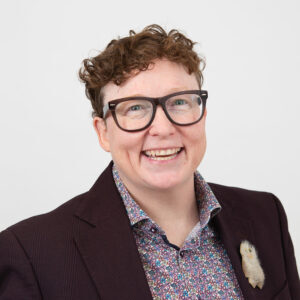
Dr. Jackie Dawson is a Full Professor and Tier 1 Canada Research Chair in Human and Policy Dimensions of Environmental Change in the Department of Geography, Environment, and Geomatics at the University of Ottawa. She is also a Research in Residence in the Office of the Chief Science Advisor to the Prime Minister and was recently appointed the inaugural Director of the University of Ottawa’s Arctic Research Hub. She previously served as the Scientific Director of Canada’s Network of Centres of Excellence, ArcticNet from 2018-24. She obtained her PhD from the University of Waterloo, Canada and her Masters from the University of Otago, New Zealand.
Dr. Dawson is an applied scientist working on the human and policy dimensions of environmental change. Her research is focused on climate change impacts, risks, and adaptation strategies in the areas of Arctic shipping, transportation, and oceans governance. She has published over 175 peer reviewed journal articles, technical reports, and book chapters, including in the high impact journals of Science and Nature. Her H-index is 48, i10 index is 116, and her research is regularly cited in scholarly literature, public policy documents, and popular media. She has secured over $200 million in research funding and supported over 40 graduate students and 65 Inuit youth researchers. She is sought-after in the media and as an international expert, having acted as an invited coordinating author or lead author on three Intergovernmental Panel on Climate Change reports, five Arctic Council reports, and haven given over 250 public lectures, and more than 100 media interviews across Canada and the world.
Dr. Dawson is an elected Fellow of the Royal Society of Canada and the Royal Canadian Geographic Society. She was a Dorthey Killam Fellowship holder and has been awarded the prestigious Social Sciences and Humanities Research Council Impact award in the Connections Category, the Marty Bergman Polar Medal, and also the Governor Generals Innovation Award for her visionary research and national and international leadership in Arctic science.
As the Arctic warms at several times the global rate, rapid sea-ice loss and intensifying human activity are reshaping ocean systems and community life in ways that outpace existing knowledge and planning. Dr. Dawson’s SustainME Fellowship will co‑produce new, policy‑relevant knowledge to support the sustainable, safe, and secure use of the Arctic marine environment under the dual pressures of sea‑ice decline and growing human use (shipping, tourism, resource development, and potential militarization).
Co‑designed with Inuit organizations and partners in Pond Inlet, Nunavut, the project pursues three objectives:
- Establish observations and projections of sea‑ice change that integrate Indigenous (IK) and Local Knowledge (LK) with state‑of‑the‑art modelling and participatory validation;
- Characterize cascading impacts and risks to sea ice and marine waters, local travel and transport, living marine resources, and well‑being and food security; and
- Identify feasible adaptation policies and solutions and quantify residual risk to inform decision‑making across community, regional, and national scales.
Methodologically, SustainME blends scientific and Indigenous research approaches under the Aajiiqatigiingniq Research Methodology (ARM)—an equitable, iterative process grounded in trusted relationships and solution‑oriented collaboration. Five interdisciplinary, iterative Work Packages span: participatory sea‑ice model design and downscaling; travel and shipping risk assessment under 2–4 °C warming; impacts of climate change and ship‑source noise on key marine species; evaluation of Arctic food systems and re‑supply vulnerabilities; and co‑development of adaptation options with risk/residual‑risk visualizations for end users.
Anticipated impact includes more accurate, locally relevant projections; democratized modelling outputs accessible to Arctic communities; and an open‑source risk application to guide adaptation investments. Building on award‑winning partnerships and pan‑Arctic datasets, the Fellowship will advance cutting‑edge climate risk and adaptation science, strengthen Inuit self‑determined governance, and deliver actionable tools that enhance safety, food security, and cultural well‑being in a rapidly changing Arctic.