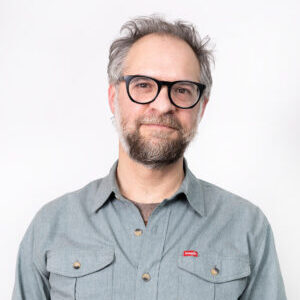
French Canadian Palestinian, Guillaume Jabbour centers his practice around sound, research-creation and community engagement. He holds an MA in Media Studies and is currently pursuing a SSHRC-funded PhD in Communication Studies at Concordia University in Tiohtià:ke/Montreal. His research-creation project involves engaging with the lived experience of Palestinians, wherever they may be, through music, sound and radical acts of deep listening. Jabbour is a member of the Resisting Colonizations collective, a multidisciplinary academic and community working group. As a musician and community sound artist, he regularly performs folk music and facilitates workshops with community groups of all ages, exploring the beauty and power of sound. He is a student affiliate of Concordia’s Center for Oral History and Digital Storytelling (COHDS), the Center for the Study of Learning and Performance (CSLP) and the Ageing + Community + Technology Lab (ACT). Jabbour lives with his wife and two teenagers in a rural community in Quebec’s lower Laurentians.
Delayed Return: An Ethnography of Music and Sound among Diasporic Palestinians
As a second generation Canadian who has never travelled to my Palestinian family’s country of origin, I hold a fragmented notion of what it means to be Palestinian. As a sound studies scholar, I am particularly interested in how diasporic Palestinians conceptualize the sound of home. What sounds make up the living soundscape of diasporic Palestinians? How do diasporic Palestinians conceptualize the sound of home? How do diasporic Palestinians listen to their surroundings? How do these listening practices inform complex identities? In response to these questions, during this research-creation project, I will conduct an ethnography of music and sound among diasporic Palestinians. Through the production of soundscapes and an interactive exhibit, this project will amplify voices, contemporary and traditional customs, and concerns of diasporic Palestinians as a means of valuing this form of resilient knowledge and presenting nuanced narratives of what it means to be Palestinian.
Due in part to a desire on my family’s behalf to assimilate quickly as newcomers to Canada in the 1960s, they refrained from handing down their Arabic mother tongue, childhood songs and customs. My heritage has been conveyed to me in fragments through memories, artefacts, trauma, and documents relating to land ownership and policies supporting displacement. Since 1948, Palestinians living in Israel, and later in the occupied territories, have experienced a two-tiered system of apartheid, extreme violence, and a suppression of cultural expression. Palestinian narratives have also been suppressed more recently as a response to Hamas’ horrendous attack on Israeli citizens, which has led to the vilification of Palestinians and their allies by the mainstream media, many politicians and public figures.
The aims of this PhD project are to 1) understand how to reconcile issues related to displacement, migration, and intergenerational trauma among diasporic Palestinians, 2) work collaboratively with diasporic Palestinians to build a playlist of 8 soundscape compositions - amounting to one soundscape composition for each decade since the United Nation’s partition plan was actualized, 3) disseminate the work and research findings in an exhibit allowing the public to interact with the recordings in a tactile manner, developing an embodied relationship with the research.