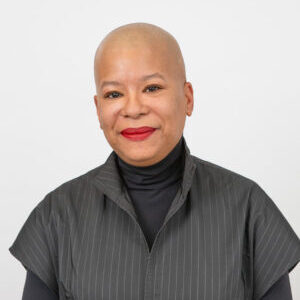
Christina Sharpe is a writer, Professor, and Tier 1 Canada Research Chair in Black Studies in the Humanities at York University in Toronto. She is also a Research Associate, at the Johannesburg Institute for Advanced Study (JIAS), University of Johannesburg. Sharpe is the author of Monstrous Intimacies: Making Post-Slavery Subjects (2010), In the Wake: On Blackness and Being (2016), and Ordinary Notes (2023)—winner of the Hilary Weston Writer’s Trust Prize in Nonfiction and the Hodler Prize and a Finalist for the National Book Award and National Book Critics Circle Award in Nonfiction. Ordinary Notes was also named a Best Book of the Year by: The New York Times, The Atlantic, The New Yorker, The Globe and Mail, The Toronto Star, NPR, New York Magazine, and Granta, among others. Sharpe is currently working on What Could a Vessel Be? (FSG/Knopf, Canada 2027), Black. Still. Life. (Duke 2027) and To Have Been to the End of the World: Essays on Art. She is one of the editors of the forthcoming Thinking from Black: A Lexicon. Her writing has appeared in many artist catalogues and journals including Small Axe, Frieze, Paris Review, Harpers, BOMB Magazine, and The Funambulist.
In 2024 she was awarded the Canada Council for the Arts Molson Prize for the Sciences and Humanities, a Windham-Campbell Prize in Nonfiction, and a Guggenheim Fellowship. In 2025 she received the Killam Prize.
Black life and study: The Alchemy Lecture; BLACK: Lab and Black. Still. Life
Dr. Christina Sharpe’s Fellowship research advances an expansive, public-facing vision of Black Studies that is grounded in collaboration, creative practice, and intellectual community-building across Canada and the world. Rooted in her longstanding commitment to gathering thinkers, artists, writers, and activists, the project extends Sharpe’s influential work on Black life, aesthetics, and imagination by developing new spaces of collective study and making that centre Black and Indigenous thought.
The Fellowship will support three interconnected initiatives. The Alchemy Lecture, already a major public event bringing together internationally renowned practitioners across disciplines, will continue to cultivate a transformative intellectual space that dissolves boundaries between genres and forms of knowledge. With live and recorded programming, ASL interpretation, and broad public access, the series models how scholarly work can speak urgently and imaginatively to contemporary conditions.
Second, the Fellowship will help launch BLACK: Lab, an interdisciplinary research‑creation and knowledge‑mobilization project involving collaborators across Canada, the United States, South Africa, Brazil, and elsewhere. BLACK: Lab uses making printmaking, letterpress, collage, zine production, curation as a method of inquiry central to Black thought and visual culture. Through workshops, reading groups, and site‑specific engagements, the Lab will foster embodied, process‑based modes of learning that cross borders even amid tightening global restrictions on movement.
Third, the Fellowship will expand Sharpe’s ongoing Canada Research Chair project, Black. Still. Life, which convenes scholars, artists, and students to explore how Black people generate forms of survival, creativity, and world‑making in the face of structural anti‑Blackness.
Together, these initiatives will create a vibrant hub for Black Studies at York University, provide training for emerging scholars through experiential and creative methods, and produce diverse public-facing outputs from exhibitions and seminars to zines and collaborative publications. The project ultimately strengthens Canada’s leadership in global Black Studies and deepens the country’s capacity for imaginative, interdisciplinary inquiry.