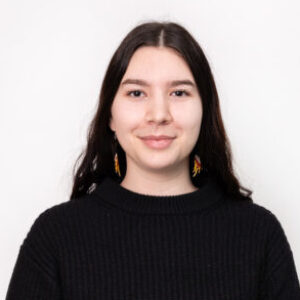
Megan Légaré is a PhD student in Family Medicine at McGill University, of Kanien’kehá:ka and European settler heritage. Her work is grounded in a commitment to Indigenous youth empowerment and culturally grounded approaches to health and community well-being. Her doctoral research in Nunavik explores how intergenerational dialogue can strengthen youth house services and better support Inuit youth.
Megan’s academic and professional journey has centered on empowering Indigenous youth’s voices. During her MA in Social Sciences, she examined Indigenous youth resurgence and generativity within reconciliation spaces. She has contributed to numerous national, community-based and participatory research/program initiatives, including co-creating and evaluating a national youth generativity and reconciliation conference with the Students Commission of Canada, and volunteering with the Kahnawake School of Diabetes Prevention Program.
With experience as a researcher, coordinator, and consultant, Megan is dedicated to fostering meaningful relationships with Indigenous communities, youth, and Elders. Her work aims to elevate Indigenous youth voices in research and decision-making while supporting community-led, culturally rooted pathways to self-determination and well-being.
Intergenerational dialogue to engage service providers, elders, and youth in improving services in Nunavik youth houses.
The Inuit-led Nunavik Youth House Association (NYHA) aims to adapt services to meet youth needs and strengthen cultural continuity. NYHA management identified challenges in engaging users and staff and requested support to address these issues that hinder their mission. I will conduct this project as part of a broader CIHR-funded initiative to co-design culturally safe services in Nunavik.
The UN describes youth engagement as young people actively participating in their development and community roles, influencing decisions on their Socio-Economic and Political growth. Valuing their insights and experiences alongside supportive adults empowers them and can help solve community issues.
The goal is to examine how intergenerational dialogue improves youth engagement and services in Nunavik youth houses through participatory research.
- Identifying gaps: A scoping review will collate literature on participatory evaluations and adaptive management strategies concerning service delivery for Indigenous youth, to highlight effective practices and identify gaps in youth engagement.
- Service provider & youth visions: Service providers will initially meet separately to identify barriers and opportunities for improving youth house services through sharing circles, reflecting Inuit traditions. Youth will share their experiences and needs via a photovoice activity to identify approaches to foster their meaningful engagement in programs and services.
- Intergenerational dialogue & collaboration: Service providers, youth, Elders, and community members will engage in dialogues to generate intervention options and fostering collaboration to boost youth engagement. Stakeholders will then address actions, protocols, or guidelines to enhance engagement and motivation. For example, staff and management will redevelop programming, while service providers and youth may consult Elders about cultural practices.
- Evaluation: After one year, a co-designed post-retrospective survey will evaluate youth benefits. Informing NYHA expansion to other communities and its impacts on youth.
This project will enhance youth engagement in services improvement at Nunavik youth houses by prioritizing Inuit voices, leadership, and knowledge. It shifts from research neglecting Inuit priorities, focusing on Inuit organizations and youth as agents of change. This establishes a precedent for culturally grounded research that promotes Inuit rights to self-determination.