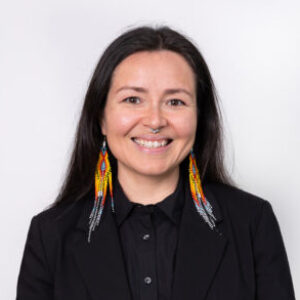
Audrey Medwayosh is Anishinaabe (Potawatomi) and a citizen of the Wasauksing Nation in Parry Sound, Ontario. She is a doctoral student in the Faculty of Native Studies at the University of Alberta. Her research focuses on deathcare processes for urban Indigenous people. This work is supported by community-based participatory research and research creation, both seen as meaningful and culturally relevant pathways to community-building and healing. Medwayosh’s work is informed by critical Indigenous theory, Indigenous feminist theory, and theories of power drawn from Foucault’s work on biopower and Mbembe’s work on necropolitics. Medwayosh holds a BA in English Literature and a BA (honours) in Anthropology, both from the University of British Columbia. She obtained her MA in Sociology at the University of Alberta, where her thesis looked at urban Indigenous experiences of grief and bereavement. In addition to her graduate research, she also works passionately in decolonizing Indigenous women’s health and program delivery for incarcerated Indigenous people through multiple research appointments.
Urban Indigenous Approaches to Deathcare
“Death is the great equalizer” is a phrase I have often heard at death studies conferences around the world. This statement overlooks the experiences of death for racialized bodies, who disproportionately die from untimely, violent, and preventable deaths. In turn, deathcare practices for these groups are different from those who experience a “good death” with particular attention to minimizing suffering. My doctoral research asks: 1. What are the death care practices at end-of-life for urban Indigenous peoples, particularly in the event of sudden and violent deaths because of systemic inequality and structural racism? and 2. How do colonial approaches to deathcare contribute to Indigenous erasure? Followed by the sub question: 3. How can existing practices of death care for urban Indigenous peoples be indigenized? The research questions will be answered through community-based participatory research (CBPR) methodologies, directly involving members of the urban Indigenous community, as well as through research creation methods. CBPR will support community ownership of the research project, centering Indigenous ways of knowing, further indigenizing death-studies. Indigenous perspectives on deathcare work are notably absent in both the literature and in practice, particularly for urban-dwelling Indigenous peoples. The urban Indigenous population is disproportionately affected by social inequities, leading to higher rates of premature death involving homicide, suicide, preventable health issues, infant mortality rates, and accidents. Indigenous near absence in death care scholarship highlights the need to understand Indigenous approaches to death care that are rooted in Indigenous epistemologies of relationality.
My research will methodologically and theoretically contribute to the study of Indigenous death care in Canada, of which there is virtually none. The research will help identify what is required and possible for people whose death is often complexly intertwined with colonialism, intergenerational trauma, and disenfranchised grief and ambiguous loss. My work will also advance Indigenous understandings of healing and grief. Death work for Indigenous peoples is not an opportunity to perpetuate reductive, deficit-based research but, rather, a means of engaging in culturally relevant healing practices. Finally, collaborative, community-engaged research puts community-first and is poignant for uniting urban Indigenous community members.